
Mississippi County Projected vs Actual Release
A projected date is a calculation or tentative plan. An actual release is the completed custody transaction. Missouri DOC uses several precise terms, and they are not interchangeable. The minimum release date is the conditional-release date for a qualifying sentence. The maximum release date is the expiration day of that sentence. A presumptive parole release date remains tentative because conduct and an acceptable release plan can affect it. A parole hearing or Board consideration date is only a process date.
County jail records work differently. A pretrial detainee has not received a sentence-release calculation. Release can follow bond, recognizance, dismissal, a later court order, or transfer to another authority. A sentenced county-jail inmate may have a calculated end date, but Mississippi County publishes no online policy or calculator for county good time, weekend processing, or holiday adjustments. The jail's actual release entry and the judgment are the reliable sources.
Scheduled versus actual: Never report a future date as a completed release. Confirm the book-out, destination, and receiving agency after the event.
Find a Mississippi County Projected Date
Start by deciding which office owns the record. Southeast Correctional Center is a Missouri DOC prison in Charleston. The Mississippi County Detention Center is a county jail. Their records are not merged merely because both facilities are in the same city. State-sentence information belongs in DOC records; local custody and book-out information belongs with the sheriff and the sentencing court.
- Identify the facility and determine whether the person is pretrial, serving a county sentence, or serving a DOC sentence.
- For a DOC prisoner, search the Missouri DOC offender search by DOC number when possible.
- Match the person by date of birth, cause number, sentencing county, and offense rows.
- Read the exact release field shown. Do not rename it “projected release” if the source says minimum, maximum, or parole date.
- For completed or older DOC history, consult the nightly Sunshine file and its field layout.
- For a county-jail sentence, obtain the written judgment and ask the sheriff for the jail calculation and release entry.
A current DOC result may show a prison or a field assignment. Field means community supervision, not prison custody. A person can remain under DOC authority after leaving SECC. The broader Mississippi County released-inmate search helps trace the actual event when the date has passed.
Missouri DOC Release Date Fields
The interactive offender search provides a current public snapshot, but Missouri DOC's Sunshine Law offender-data page supplies the dependable field dictionary and nightly historical files. Those files cover people who are or have been under DOC supervision. Search every row for the person because one completed sentence does not mean all sentences are complete.
| Field or value | Meaning for a release date |
|---|---|
| $PC | Sentence minimum release date, defined as the calculated conditional-release date for the active sentence |
| $PD | Sentence maximum release date, or the expiration day of that sentence |
| $SCF=Y | That sentence is completed; other sentence rows may remain active |
| $CCI | Shows single or primary, concurrent, or consecutive sentence relationship |
| $FOI=I | Assigned place is an institution |
| $FOI=F | Assigned place is a field district under community supervision |
The official DOC search form is shown below so the source and its search fields can be recognized before entering a name.
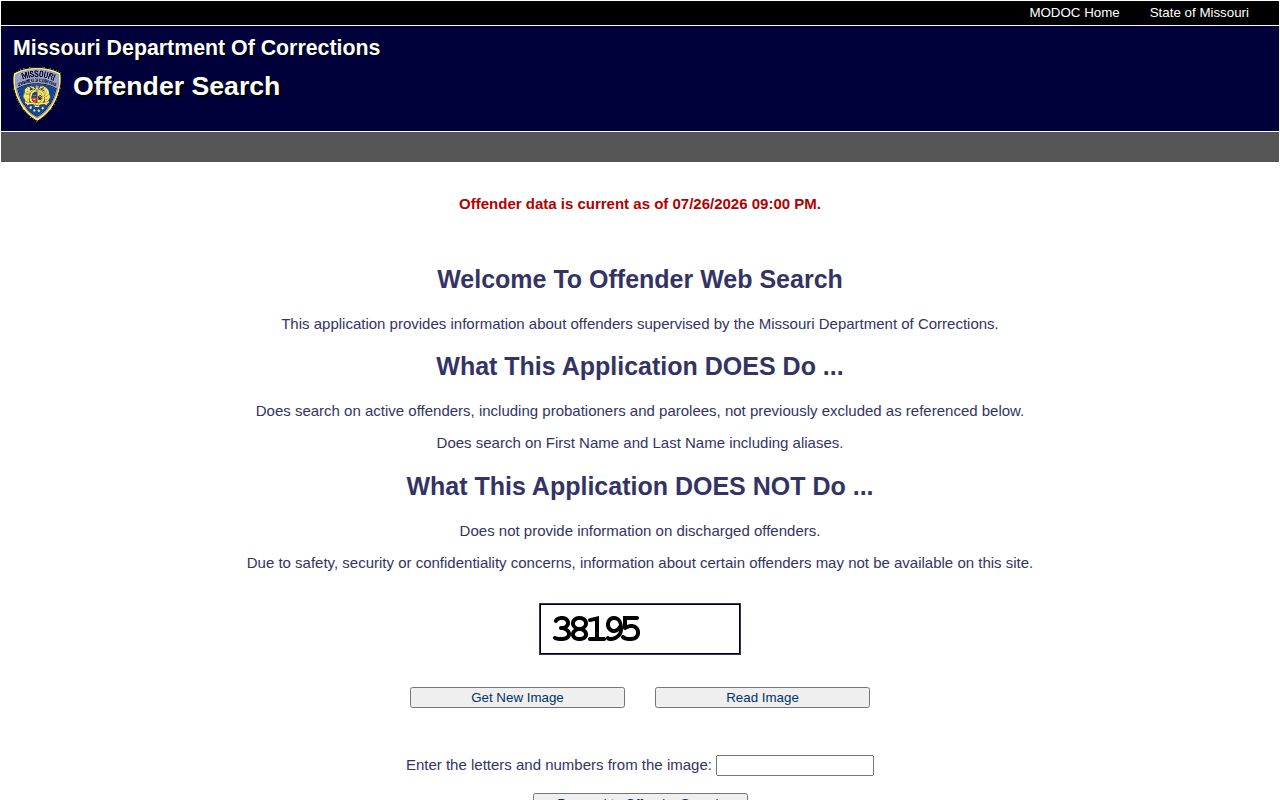
The form is only the first step. A matching record must still be tied to the right court case, sentence row, and assigned place.
Note: One completed DOC sentence row does not prove that every sentence or custody obligation has ended.
Mississippi County Conditional Release Terms
RSMo § 558.011(4) divides many qualifying terms of years into a prison term and a conditional-release term. For a term of nine years or less, the conditional-release portion is one-third. For more than nine through fifteen years, it is three years. For more than fifteen years, it is five years. The prison term is the remainder. The Parole Board may extend the prison portion through the statutory violation process.
That framework has exceptions. Dangerous felonies, certain repeat DOC remands, and other statutory categories do not fit the same general division. Even when the general rule applies, a simple sentence fraction is not a safe release prediction. Sentence date, offense category, concurrent or consecutive structure, jail credit, Board action, treatment requirements, and conduct may all affect the operational date.
A minimum release date should therefore be read as a defined DOC field, not a guarantee that a person will walk out of SECC on that day. Confirm the assigned place after the date. A move from SECC to another prison is still institutional custody. A field assignment can show community supervision.
Mississippi County Minimum Prison Terms
The phrase “85 percent law” is often used too broadly. RSMo § 558.019 is the place to check minimum prison terms for covered cases, including special rules for dangerous felonies and rules tied to prior prison commitments. It is not a universal formula for every Missouri prisoner. It does not set the release date for every county-jail sentence, probation term, or felony.
Offense date matters because an earlier version of a statute may govern older conduct. The current version must be read with the judgment, the date of the offense, and the statutory definition of dangerous felony. A charge description in a news item or docket header is not enough to perform an individual calculation. The entered judgment and sentence control.
When a minimum-service rule applies, it affects parole eligibility or the time that must be served. It does not automatically reveal the actual gate date. Detainers, other sentences, a later court order, or Board action can still prevent release to the community.
Note: A sentence percentage is a legal minimum rule, not a stand-alone Mississippi County release-date calculator.
Mississippi County Good-Time Questions
RSMo § 558.041 authorizes Missouri DOC good-time credit for eligible state offenders who meet policy requirements, on the institutional superintendent's recommendation. Orderly conduct and participation in rehabilitation programs can support credit. Violations can result in loss of credit. The credit applies to the sentence being served and does not prove the calculation for another sentence.
This is a state-prison rule. It does not establish that the Mississippi County Sheriff applies the same formula to a sentence served in the county jail. No verified county good-time policy, weekend-release policy, or holiday-advance rule was found in the official local material. For a local sentence, request the jail's actual calculation and the release transaction rather than using DOC good time.
Earned compliance credit is different. Missouri DOC describes it as a path to early discharge from eligible probation, parole, or conditional-release supervision. It can shorten the supervision period after prison release. It should not be subtracted from the prison date. The offense, sentence date, and eligibility rules still matter.
Why Mississippi County Release Dates Change
A release date can move because the record itself changes or because another authority prevents the planned community release. The exact reason should come from DOC, the court, or the jail record. Do not guess from a roster disappearance or a single stale search result.
| Factor | Possible effect | Best confirmation source |
|---|---|---|
| Conduct or credit loss | Moves an eligible DOC calculation later | DOC sentence and institutional record |
| Corrected jail credit | Changes time credited before DOC delivery | Judgment, amended order, and DOC |
| Concurrent or consecutive terms | Terms run together or stack | Judgment and $CCI field |
| Parole Board action | Grants, denies, delays, or conditions parole | Board decision and DOC record |
| Detainer or hold | Causes transfer instead of community release | Holding and receiving agencies |
| New or appellate order | Changes the sentence or custody authority | Court docket and certified order |
| Treatment requirement | May affect an operational date in covered cases | DOC and statutory record |
For consecutive sentences, RSMo § 217.690 addresses addition of minimum eligibility terms, subject to its cap. That is one more reason to review all sentence rows instead of calculating from the longest charge alone.
Note: A projected date can move when the judgment, credit, sentence relationship, hold, conduct record, or Board decision changes.
Charleston’s Two Release Systems
The most important local check is the “two-system Charleston” problem. A person can leave Southeast Correctional Center for another DOC prison, leave SECC for field supervision, or leave the Mississippi County Detention Center for DOC intake. Each event can be called a release from Charleston in casual speech. Only the source record reveals whether the person entered the community.
Read the DOC assigned place and institution-or-field value. For a county book-out, ask the sheriff for the release type, authority, and destination or receiving agency. A transfer to DOC, another county, USMS, or another hold is not the same as release with no remaining custody. Case.net can explain the judicial order but does not replace the physical release log.
SECC is also a statewide prison. A person released from that institution may have been sentenced in another Missouri county and may report to a field office elsewhere. Physical presence in Mississippi County does not establish that the county court owns the sentence or that District 14 will supervise the person.
Confirm a Mississippi County Release Date
After finding a future date, confirm it with the office that owns the sentence. For a state prisoner, use DOC Constituent Services at 573-526-2695 or constituentservices@doc.mo.gov. Provide the full name, DOC number, cause number, and the specific date field in question. For Parole Board information, use 573-751-8488 or DOC.MissouriParoleBoard@doc.mo.gov. Detailed release-plan and supervision material may be closed.
For the Mississippi County jail, call the Sheriff's Office at 573-683-2111 and ask for the records custodian's preferred request method. The official county page provides no online release archive, dedicated records email, or published county calculation policy. Ask for the written release entry, actual release time, release authority, and receiving agency. Pair that record with the Circuit Clerk's judgment or later order.
Missouri MOVANS can add an event alert, but an alert is not the sole custody record. The current registration method and its limits are detailed under VINELink Inmate Search. When the event occurs, verify the actual destination, especially when another agency hold exists.
A focused records request can resolve a mismatch after the date passes. For DOC, identify the person by full name and DOC number, then ask for public fields explaining the actual release or discharge. Include the cause number and date range when known. For a county record, request an existing booking and custody-release entry rather than asking staff to create a new calculation. If one portion is closed, ask for the open portions and the legal basis for each withheld part.
Missouri's three-business-day Sunshine Law rule governs access or a detailed delay response, not a promise that every large request will be finished in that period. Ask for an estimate before work begins because the county publishes no local copy-fee sheet. A certified court order can establish the judicial authority, while the jail or DOC transaction establishes where the person physically went.