
Mississippi County Parole or Probation?
Parole is release from a Missouri prison before the maximum sentence expires, subject to rules set through the state corrections process. The Missouri Parole Board makes parole decisions. Field supervision is then carried out by the Missouri Department of Corrections Division of Probation and Parole. Probation starts with a court judgment. It usually allows the person to remain in the community instead of serving all or part of a jail or prison term, but the court retains authority over the sentence.
Conditional release is a third term that often causes confusion. It is the community portion of certain Missouri prison sentences. A person on conditional release is still under DOC supervision even though the person has left an institution. None of these terms means that the conviction, judgment, or sentence vanished. They describe legal status after a court order or movement from prison to the community.
| Status | Who authorizes it | Where to verify |
|---|---|---|
| Parole | Missouri Parole Board | DOC offender search, Board, and assigned field office |
| Probation | Sentencing court | Case.net, judgment, DOC search, and field office |
| Conditional release | Missouri sentence law and DOC process | DOC sentence fields and assigned field office |
| Discharge | DOC, Board, or court as applicable | DOC history, discharge order, or court docket |
Verify Mississippi County Post-Release Supervision
The first public check is the Missouri DOC offender search. It is aimed at people who are incarcerated or under supervision. A person released from Southeast Correctional Center may remain visible because a field office, rather than a prison, is the assigned place. A person who has completed every term may no longer appear in the interactive search, so an empty result is not proof that the person was never supervised.
Use a DOC number when it is known. It is more reliable than a name. If a name search returns several people, compare birth information, cause numbers, sentencing county, and offense entries. Then follow a simple verification path:
- Search the exact name and reasonable name variants, or enter the DOC number.
- Open only the record whose identifiers and court case match.
- Check whether the assigned place is an institution or a field district.
- Compare the cause number with the Missouri Case.net court docket.
- Contact the listed field office or DOC for current public status information.
Missouri DOC warns that online information may not be current. For a completed record, use the nightly Sunshine Law offender files or make a focused DOC records request. Those files can show a completed-sentence flag and the relationship among concurrent or consecutive sentences. Most detailed supervision case notes remain closed.
The Missouri Parole Board page provides current Board contacts, rules, and its time-to-serve materials.
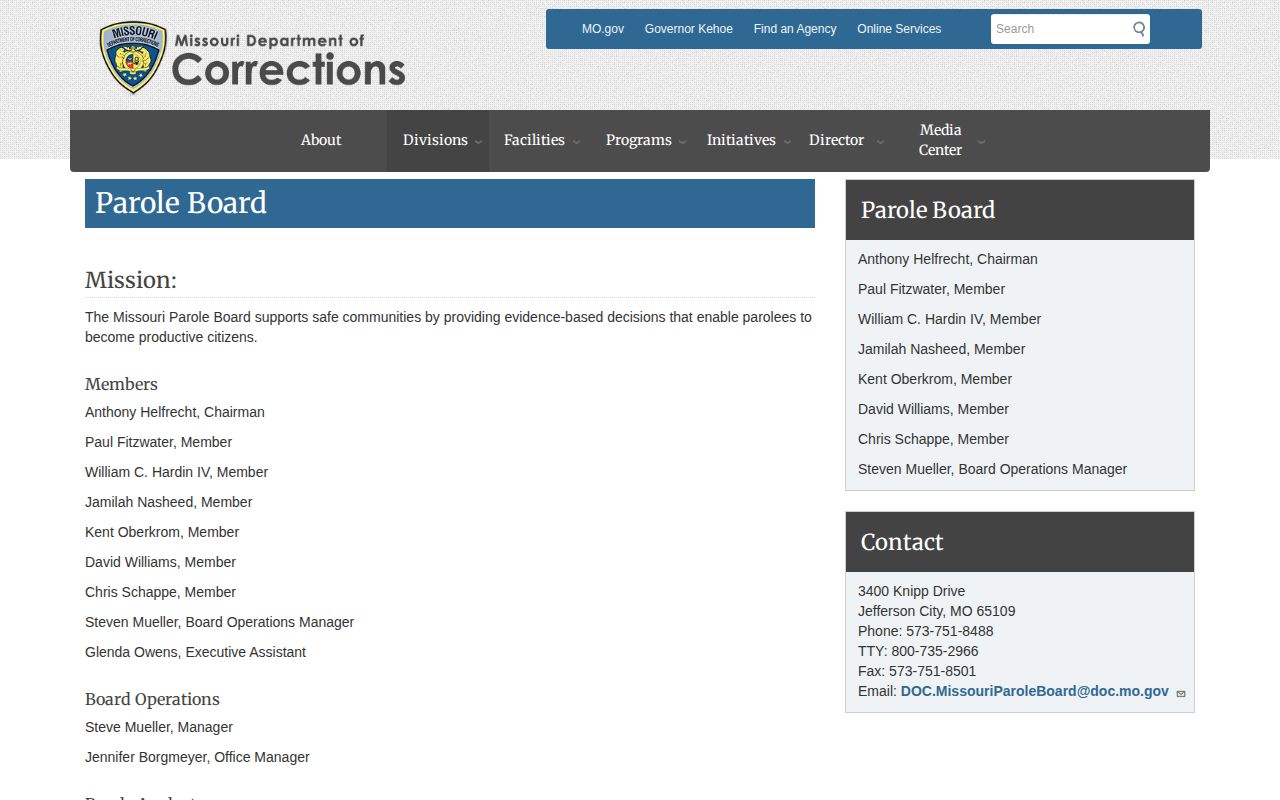
Use the Board source for parole decisions and rules, then use District 14 or the assigned field office for current local supervision questions.
Important: A field assignment supports current community supervision. An old field assignment, standing alone, does not prove that supervision remains active today.
Mississippi County District 14 Office
Mississippi County is served by Probation and Parole District 14. An older official District 14 guide places the main office in Sikeston and identifies a Charleston satellite. This local route matters when a DOC result shows field supervision but does not answer a practical status question. Because the published guide is dated, confirm the office details through the current Division of Probation and Parole listing before relying on them.
District 14 main office
102 Arthur Drive
Sikeston, MO 63801
573-472-5353
Fax: 573-472-6622
Charleston satellite
305 S. Cooper
Charleston, MO 63834
573-683-3673
Fax: 573-683-4297
The older official guide lists weekday hours of 8 a.m. to 5 p.m. Verify both locations and hours before a visit.
For a direct Parole Board inquiry, use 573-751-8488 or DOC.MissouriParoleBoard@doc.mo.gov. Provide a full name, DOC number if known, and a clear request for public status or decision information. A concise request gets closer to the answer than a broad demand for the whole supervision file.
Note: District 14 serves Mississippi, Scott, and New Madrid Counties, so the office name may not repeat the county name in a search result.
Mississippi County Supervision Terms
Conditions are the enforceable rules attached to parole, conditional release, or probation. The exact terms come from the Board, DOC, and court record for that person. Common high-level areas include reporting as directed, obeying laws and court orders, staying within approved travel limits, and completing required programming. The public search does not expose every condition or the officer's case notes. Those records may contain private or closed material.
A violation does not always produce the same outcome. The supervising authority may investigate, change instructions, pursue a sanction, or begin revocation action. A court handles probation authority, while parole and conditional-release action follows the state corrections and Board process. The docket or an official status check is needed before treating an alleged violation as a revocation.
- Field supervision
- Community oversight by an assigned probation and parole office.
- Absconder
- An official status tied to unknown whereabouts or noncompliance, not merely a missed casual meeting.
- Revocation
- A formal action that can end community supervision and return a person to custody.
- Discharge
- The legal end of a sentence or supervision term.
Note: General supervision rules do not reveal the private conditions or current compliance status in a specific Mississippi County case.
Mississippi County Absconder Records
An absconder label needs a source. The DOC offender search may show a supervision status, while the Missouri State Highway Patrol sex-offender registry uses its own set of status terms for covered registrants. Those systems answer different questions. A registry absconder entry does not prove that every parole or probation rule was violated, and the registry is not a general list of everyone under supervision.
The Mississippi County Sheriff's Office does not publish a verified general absconder list on its official page. If a warrant is the concern, check the court case and contact the agency or court that could confirm it. Do not infer a warrant from silence in MOVANS or from the absence of a person in the jail app. A person can be out of local jail custody while a court or state warrant remains active.
For notification about a custody change, the current Missouri service is MOVANS. It can support notification for local jail, DOC, and court events, but it does not replace an official warrant or supervision-status check.
SECC Release and Local Reentry
Southeast Correctional Center is in Charleston, but it is a Missouri DOC prison. It is not run by the Mississippi County Sheriff. DOC states that every Missouri prison has a reentry center. A person preparing to leave SECC can work with institutional reentry staff and the parole office on the approved plan before release. District 14 resources then provide a local supervision path for Mississippi County, Scott County, and New Madrid County.
This distinction prevents a common records error. Leaving SECC can mean transfer to another DOC institution, release to a field office, conditional release, parole, or full discharge. A county-jail bond release follows a different path. The assigned-place field and release record must show whether the person moved from an institution to the community. The sheriff does not manage a state prisoner's parole plan simply because SECC and the county jail are both in Charleston.
The DOC Reentry Services office is the official source for the state-prison process. The Mississippi County released-inmate search paths explain how to separate a local jail book-out from a DOC transfer or discharge.
Mississippi County Release Documents
DOC's glossary identifies essential core service documents used in release planning. The set includes a birth certificate, state identification card, Social Security card, military discharge certificate when applicable, and an education credential. For a person still at SECC, the prison reentry center is the right place to address missing items before release. An already released person may need the issuing agency, DOC Constituent Services, or the court for replacement records.
These documents are not the same as proof of supervision. A release plan or identity document can help with the move back to the community, but current parole or probation status comes from DOC and the supervising office. Likewise, a discharge certificate proves a specific corrections event. It should be read with the sentence and cause number when more than one case exists.
If a public sex-offender registry entry is wrong, the MSHP registry instructions direct correction questions to the resident county sheriff or the registry unit. That route corrects a registry record; it does not alter the underlying judgment or DOC supervision file.
Ending Mississippi County Supervision
Supervision ends through discharge, expiration, or another authorized action. Missouri DOC describes early discharge as final release from probation, parole, or conditional-release supervision before the scheduled end. Eligibility and earned-compliance rules depend on the offense and sentence date. Earned compliance can shorten an eligible supervision term. It is not prison good time, and it should not be used to recalculate a past prison release date.
To confirm the end of supervision, start with the DOC search and historical file. Then match the DOC number, cause number, and completed-sentence information. A court docket may contain a probation discharge or revocation order. The Parole Board records contact can address a focused request for public Board decision information, though underlying supervision files are often closed.
Final discharge is different from release to parole. A person discharged from all relevant terms is no longer supervised on those terms. When several sentences exist, one completed flag does not prove that every sentence ended. Review every row and its concurrent or consecutive relationship, then seek an official explanation when the records conflict.
Note: A live jail roster shows present jail custody, not whether a released person remains on Missouri probation, parole, or conditional release.